The Great Fire

London, 1666.

Before the fire.

Before the truth.

PART I

BEFORE THE TRUTH

Thomas and Isabel at the engagement party
The engagement

A city alive with possibility.

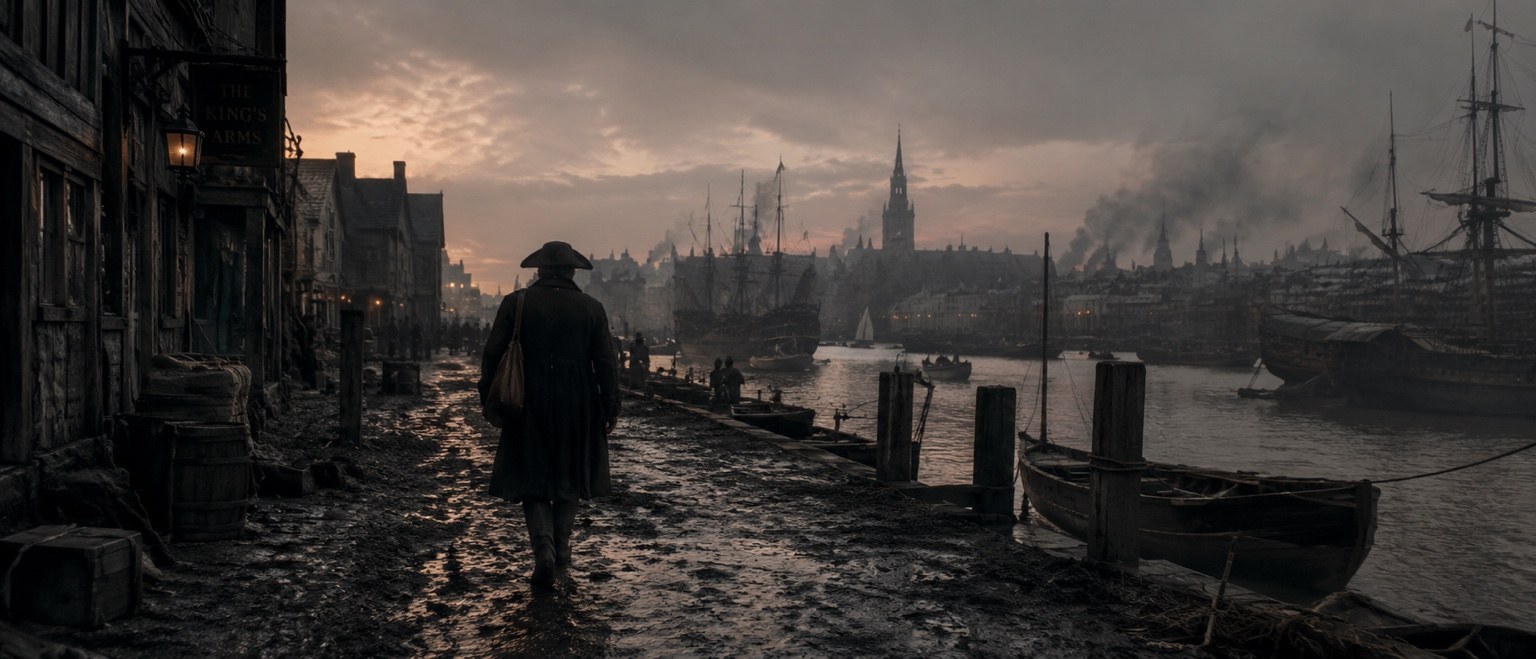
The Thames is thick with ships from every corner of the world.

The streets teem with merchants, laborers, apprentices, thieves and gentlemen, all moving through the narrow arteries of a city growing richer by the day.

Church bells carry across rooftops.

Smoke rises from a thousand chimneys.

Everywhere, something is being built.

Wealth flows into London faster than its ancient streets can contain it.

Foreign tongues fill the markets.

Fortunes are made overnight.

And beneath the prosperity lies unease.

A city crowded behind medieval walls.

Suspicious of strangers.

Quick to anger.

Certain that tomorrow will be richer than today.

Among London’s merchant families, few are more admired than the Ashcombes. Their prosperity seems effortless. Their happiness even more so.

On a warm summer evening, friends, relatives and business associates gather in the Ashcombe garden to celebrate the engagement of Isabel Ashcombe and Thomas Blackwell.

No one is surprised.

The announcement merely confirms what everyone has known for years.

Thomas and Isabel have grown up together. They move through each other’s lives with the ease of people who cannot remember a time when the other was absent. Their marriage feels less like a decision than the natural conclusion to a story that has been writing itself since childhood.

Beneath lanterns strung between the apple trees, guests drink wine and offer congratulations. Laughter drifts across the lawn. Musicians play softly in the background while servants move through the crowd with silver trays.

Thomas and Isabel stand at the center of it all.

Not because they seek attention.

Because happiness draws the eye.

They exchange smiles that need no explanation. The future stretches before them, obvious and unquestioned. A home. Children. A lifetime spent together.

Around them, two families celebrate becoming one.

Across the garden sits Robert Ashcombe, his wife Agnes beside him chatting to well-wishers.

Charming, generous and relentlessly capable, Robert has become the sort of man others seek out in moments of uncertainty. Merchants trust him. Friends admire him. Young men hope to become him.

He watches the couple.

Pretends not to.

No one loves Isabel more fiercely than her father.

Not with the possessiveness of a tyrant.

Nor the vanity of a man who sees his daughter as an extension of himself.

His love is simpler.

And far more dangerous.

He cannot imagine a world in which she suffers.

As the evening progresses, guests begin calling for a toast.

Henry Blackwell rises first.

Robert’s second cousin.

His oldest friend.

His business partner.

Raised almost as brothers, their lives have become so intertwined that few know where one family’s interests end and the other’s begin.

Henry lifts his glass.

"To Thomas and Isabel. To everything that lies ahead."

The guests cheer.

Thomas takes Isabel’s hand.

For a moment the entire garden seems suspended in perfect balance.

Everything Robert has spent a lifetime building sits before him.

His family.

His fortune.

His friendships.

His daughter.

The future she deserves.

Then a servant appears quietly beside him with a letter.

The envelope is plain.

No seal.

No mark.

Nothing remarkable about it at all.

Robert accepts it absentmindedly.

The celebration continues around him.

Another toast.

More laughter.

A violin somewhere in the darkness.

He opens the letter.

Reads a single line.

And the color drains from his face.

Twenty-five years vanish.

The music disappears.

The garden disappears.

The life he has built disappears.

There is only the handwriting.

Four words.

I’ve come for John.

PART II

A GOLDEN PROBLEM

Three days after the engagement party, Robert arrives at a deserted warehouse near the river.

The building is empty.

Or appears to be.

A voice emerges from the darkness.

No face.

No name.

Only a demand.

Compensation.

The sum is substantial.

Enough to hurt.

Not enough to threaten.

Robert listens carefully.

Asks questions.

Receives no answers.

The voice refuses to reveal himself.

Wants gold.

Nothing more.

When the meeting ends, Robert leaves with a feeling he has not experienced since receiving the letter.

Relief.

Money is a problem he understands.

Money is a problem he can solve.

A low-life blackmailer is no match for a man who has spent a lifetime building an empire.

The gold is delivered.

The letters stop.

Days pass.

Then weeks.

Nothing.

No messages.

No demands.

No threats.

Robert congratulates himself on concluding the matter so gracefully.

A loose thread from another life.

Expensive.

Unpleasant.

Manageable.

The kind of problem gold was invented to solve.

And life resumes.

One afternoon Isabel finds him in the garden.

He appears to be reviewing correspondence.

In truth, he has been watching her for several minutes.

She moves through the world with the effortless confidence of someone who has never once doubted she was loved.

She settles beside him and begins talking about the wedding. Not the ceremony. The marriage. The life that comes after. A house of their own. Children. The possibility of growing old beside someone who has known you since childhood.

At some point she asks him how he knew Agnes was the one.

The question catches him off guard.

He glances toward the house.

Agnes is visible through an upstairs window, directing servants with the quiet authority she brings to everything.

"I didn’t know," he says.

"Then why did you marry her?"

Robert smiles.

"Because I couldn’t imagine my life without her."

Isabel considers this.

As though committing the answer to memory.

Then she nods.

Satisfied.

The conversation drifts elsewhere.

Yet long after she leaves, Robert remains where he is.

Watching her disappear into the house.

Trying to understand why the sight of her happiness fills him with equal measures of gratitude and sadness.

A few evenings later, after the others have retired, Henry and Robert remain alone in the garden with a final bottle of wine between them. The conversation wanders. Business. Politics. Children. Memories. The easy subjects reserved for old friends.

At one point Henry raises his glass toward the gazebo.

Beneath candlelight Thomas and Isabel are still talking.

"You know," Henry says, "we’ve become insufferable."

Robert laughs.

"Have we? Yes, we have."

"We sound like old men."

"We are old men."

Henry watches the couple beneath the lanterns.

"No. We’re fortunate men."

The remark lingers after the conversation has moved on.

Fortunate.

Robert finds himself turning the word over in his mind.

Because Henry believes it completely.

Because Henry has no reason not to.

And because there are moments when Robert almost believes it too.

Almost.

A month passes.

The fear recedes.

Life reasserts itself.

The future once again feels certain.

Then another letter arrives.

The handwriting is unmistakable.

This time Robert does not feel fear.

He feels fury.

A first payment was meant to end it.

A second would prove it would not.

The reply is sent that same day.

No more gold.

Not until the man responsible shows himself.

Several days later an answer arrives.

A place.

A time.

The Royal Exchange.

And, for the first time in weeks, Robert feels in control again.

You cannot reason with a shadow.

But a man is still only a man.

And men, Robert knew, could be understood.

PART III

THE GHOST RETURNS

The Stranger returns to London
The past returns

Robert Ashcombe crosses the courtyard of the Royal Exchange as men greet him by name. Merchants nod. Clerks step aside. News of ships, prices, cargoes and fortunes moves through the air around him with the familiar music of commerce.

This is his world.

A world in which every man wants something.

Robert waits beneath the great arcade, listening to the thunder of business all around him, and feels his confidence return.

He scans the crowd.

Looking for a blackmailer.

Looking for a threat.

Looking for a man.

Then he sees him.

A man standing at the edge of the crowd while London moves around him, the Stranger.

Robert cannot move.

Older.

Weathered beyond age.

Ravaged by violence and hunger.

But the eyes are unchanged.

Twenty-five years fall away.

A ship, The Pelham, limps toward England under reduced sail.

Smoke-blackened timbers. Splintered railings. Torn rigging patched and repatched against the wind.

A younger, battle-worn Robert and the Stranger, both in their twenties, heave sheet-wrapped corpses over the side, one after another. There must be twenty.

They pause, the scorching sun finally starting to set, stretch out their withering, exhausted limbs.

The deck is eerily empty.

Near the stern, a Young Officer studies a chart spread across a barrel.

His left arm is bound tightly against his chest. The sleeve beneath the bandage is stained dark with old blood.

Even injured, command settles naturally around him.

When he speaks, men listen.

When decisions must be made, eyes turn to him.

The highest-ranking able-man left aboard, yet barely twenty.

He calls on the seamen to check on the men below deck when they are done, commanding but kind.

Nightfall now.

Below deck. The captain’s quarters, a very sick, Older Officer, pallor the color of chalk mutters feverishly in his bunk as Robert attempts to cool him with a wet cloth. The only color on his visage coming from his blue tunic and brass buttons. Leaning against the bunk stands the officer’s sword. Three feet of narrow English steel in a brass basket hilt stained green by salt air.

Duty done, Robert sets down the cloth and retrieves an uneaten dinner, eyeing it greedily, but not daring to devour it.

He heads out of the captain’s quarters and joins the Stranger who tends to several other sailors, scattered like ragdolls in various bunks, too badly wounded to stand. One mutters through a fever. Another will not survive the night.

Robert helps the injured, but his eyes keep roving to the iron-bound chests secured to the prow against the rolling sea, secured with a hefty iron padlock against the pilfering hands.

The Stranger notices, nods toward the prow.

"Three chests." he says quietly.

Robert glances around to make certain the sick cannot hear, "That’s a fortune."

The Stranger smiles.

Robert does not.

Above them, footsteps cross the deck overhead.

Both men instinctively look up.

The Young Officer.

The ship wallows on the black inky water in the middle of a cloudless night.

The ship’s bell rings once.

Robert and the Stranger bolt up from their bunks.

Robert and the Stranger sew the Older Officer’s body into canvas.

The Young Officer, Robert, the Stranger and one other sailor who has trouble standing gather silently along the rail.

A prayer is offered.

The sea takes another man.

The Young Officer steps forward.

The three other men watch him.

He watches the horizon.

The responsibility settles upon him without ceremony.

Course.

Cargo.

Crew.

Everything.

Later, below deck, Robert helps change the dressing on the Young Officer’s wound.

He winces but says nothing.

A packet of letters slips from his coat and falls to the floor.

Robert bends to retrieve them.

The seal catches his eye.

A family crest impressed into red wax.

The Young Officer notices.

"My cousin writes every month."

Robert hands the letters back.

The Young Officer smiles.

"Assuming I ever make it home, it would be nice to see him."

On the desk, a signet ring.

Heavy gold.

Beautifully made.

The Young Officer sees Robert clock it, picks it up and turns it between his fingers.

"My grandfather’s."

For a moment neither man speaks.

The ship creaks around them.

Water slaps against the hull.

Somewhere below, a wounded sailor cries out in his sleep.

The Young Officer slides the ring back onto his finger.

Robert watches.

The following morning The Young Officer is already on deck, looking brighter than the day before.

He moves carefully, favoring his injured arm, yet there is no mistaking the change.

He is recovering.

Near midday, a cry comes from the bow.

Land.

A thin dark line sits upon the horizon.

England.

For the first time since the battle, smiles appear aboard the ship.

Even the Young Officer laughs.

The sound surprises Robert.

That evening the sea remains calm.

The Stranger joins Robert near the rail.

Below them, the gold shifts softly inside its chests with the movement of the ship.

"Two days," the Stranger says.

Robert says nothing.

The Stranger grins.

"Two days and we’re rich men."

Above them the Young Officer stands beneath the fading light, studying the coastline through a brass telescope.

Later, in the captain’s quarters, Robert changes the dressing on the Young Officer’s arm. The wound is healing cleanly.

"Looks worse than it is."

Robert nods, "You have family waiting, sir".

The Young Officer smiles.

"Just that cousin. Made it easier being so long. Curious really. I haven’t seen him since I was a boy, yet we write constantly."

He taps a stack of letters on his desk.

Robert finds himself smiling despite himself.

For a moment they look less like officer and sailor than two young men returning home.

"Wait until he hears this story."

The Young Officer laughs softly.

"Though he’ll probably improve it before telling it back to me."

Robert laughs too.

The sound surprises him. The Young Officer notices.

"And you? Family?"

Robert shakes his head.

The Young Officer nods.

A small gesture.

Not pity.

Understanding.

"Then perhaps it’s time you found some."

Outside, the ship creaks gently in the darkness.

Neither man speaks.

Robert watches the ring.

The letters.

The future waiting on the other side of the sea.

The Young Officer rises.

"I’m going to turn in, my man. Double rum rations tonight, Lord knows you’ve earned them."

He pauses at the cabin door.

"And help yourself to my supper before the rats do."

Robert nods his appreciation, tinged with slight pain in those hollow eyes. "Much obliged, sir.".

The Young Officer smiles back.

"Good." Then. "Get some sleep. We’ll all be Englishmen again soon enough."

He disappears into the captain’s cabin and closes the door behind him.

The sea is calm.

The stars bright.

The Stranger disappears below deck.

Moments later his voice tears through the silence.

"Sir!"

A pause.

Then louder.

"Sir!"

The captain’s cabin door opens.

The Young Officer emerges half-dressed, immediately alert.

"What is it?"

"The forward tackle’s given way."

The Stranger points into the darkness.

"One of the chests has broken loose."

The Young Officer swears softly and starts forward.

He moves quickly despite the injury.

The ship rolls beneath his feet.

Robert waits in the shadows.

The Young Officer sees him.

Relief flickers across his face.

"There you are."

He takes another step.

"Help me with –"

Robert drives the dead officer’s sword beneath the Young Officer’s ribs.

The Young Officer stops.

Confusion.

Then pain.

His eyes find Robert’s.

For a moment neither man moves.

The sea.

The wind.

The ship.

Everything else disappears.

The Young Officer looks down at the sword.

Then back at Robert.

A thousand questions.

No time for answers.

His knees buckle.

Robert catches him before he hits the deck.

The Young Officer blood runs hot across his hands.

Within moments he is gone.

The Stranger disappears below deck to prepare the tender.

Robert remains.

The Young Officer lies where he fell.

Robert kneels beside the body.

For a moment he simply looks at the Young Officer.

The ship creaks softly around them.

Then he finds the Young Officer’s hand, grips the signet ring and twists it free.

Robert gets up and enters the captain’s cabin.

The candle still burns.

The bed remains unmade.

England waits upon the desk.

The letters.

The family seal.

A leather-bound journal.

Charts.

Papers bearing the name Robert Ashcombe.

Robert turns to the bed, grabs a pillow – removes it for its case.

He swiftly sweeps the letters, the journal, the family seal, twenty years of another man’s life into the pillowcase.

Outside, the Stranger calls for help with the chests.

Robert leaves the cabin.

The gold takes hours.

Three chests.

Rope.

Sweat.

Splintered hands.

The weight nearly breaks them.

By the time the final chest is lowered into the tender, dawn is beginning to creep across the eastern sky.

The Stranger wipes blood from his knuckles and laughs.

"We did it."

For the first time in twenty years, he sounds happy.

Robert looks back toward the ship.

Toward the cabin.

Toward the life that waits beyond the horizon.

And for the first time, the gold feels strangely small.

The tender rises and falls gently beneath them.

Three chests of gold occupy most of the space.

The ship drifts in the distance, little more than a dark shape against the brightening horizon.

The Stranger cannot stop smiling.

He keeps looking at the chests as though afraid it might disappear.

"We’ll never work another day in our lives."

Robert says nothing.

The Stranger laughs.

"We should have done it years ago."

The sea is calm.

The coastline grows clearer with every stroke of the oars.

"Poor bastard."

Robert glances up.

"Ashcombe."

The Stranger shakes his head.

"Another two days and he’d have been home."

Robert says nothing.

The Stranger keeps talking.

"He was a good sort."

A laugh.

"Better than most officers."

He points back toward the distant ship.

"Imagine his cousin waiting for him."

The words linger.

His cousin waiting for him.

Robert’s foot instinctively touches the pillowcase at his feet.

The letters.

The seal.

The journal.

The life.

The Stranger continues.

Oblivious.

"He’ll never know what happened."

Silence.

Robert’s foot touches the pillowcase again.

The Stranger keeps talking.

Already spending the gold.

Already imagining taverns and women and land.

Already imagining a life larger than the one he was born into.

Robert looks toward England.

Then back at the pillowcase.

The realization does not arrive all at once.

It settles upon him.

The gold is a fortune.

But fortunes disappear.

The life does not.

Ashcombe cannot be dead.

If Ashcombe is to live…

Robert must disappear.

The Stranger turns toward him.

Still smiling.

Still talking.

"Isn’t that right, John? Poor – "

THWACK!

A sickening crack as it lands across the Stranger’s head.

The Stranger collapses instantly.

John stands panting, holding the heavy, blood dripping oar out of the water.

Blood spreads across the floorboards.

The sea laps quietly against the hull.

John sits, sets down the oar.

Breathing.

Listening.

Waiting.

The Stranger does not move.

John hoists the Stranger overboard.

Slowly, he reaches into his pocket.

The signet ring.

Robert Ashcombe’s ring.

He studies it in the morning light.

Then slides it onto his finger.

It fits perfectly.

John and Pelham in the boat with the stolen chests
The choice that makes Robert Ashcombe.

Back at the Exchange, Robert is no longer certain he has breathed.

The square bustles around them.

Somewhere a bell rings.

Twenty-five years have vanished and returned in the space of a heartbeat.

The Stranger watches him.

Patiently.

Like a man who has waited a very long time for another man to remember.

"You were dead."

The Stranger smiles.

"Not dead enough, John."

Robert glances around them.

“Why am I not?”

“Every version ended too quickly.”

A beat.

"You’ve had your gold."

"Yes."

"Is that not enough?"

The Stranger studies him.

"I did not crawl back to this city to be purchased."

"Don’t be preposterous, that’s more than —"

"Is it?”

“I have come to claim my life."

"How could I possibly —"

"By returning yours."

Robert frowns. Then the stranger says:

"You’re going to tell Blackwell."

For a moment Robert simply stares.

"No."

"I’m going to make you tell him."

"No."

The Stranger looks around the Exchange.

At the men who nod to Robert.

At the clerks who wait for his attention.

At the world that receives him as legitimate.

The Stranger leans in.

"Remarkable."

Robert says nothing.

"All these men."

A glance around the Exchange.

"And not one of them knows who you are.”

Robert studies him.

The old instinct returns.

The one that measures weakness.

Appetite.

Fear.

The thing a man wants most.

Only here there is nothing to measure.

No greed.

No need.

No obvious wound Robert can press.

The Stranger has survived too much to be frightened by reputation.

Lost too much to be bought.

Hated too long to be hurried.

Panicking, Robert blurts:

“I could have you removed!”

“No. No, you could not.”

And the calmness and confidence with which the Stranger says it chills Robert.

"You will tell Blackwell, somehow."

Robert’s eyes flash.

The Stranger sees it.

For the first time something like satisfaction crosses his face.

"There’s my John."

A silence.

Robert turns away before the Stranger can say more.

He walks through the Exchange as men greet him, bow to him, ask his opinion, offer him news of ships newly arrived.

He hears none of it.

By the time he reaches the street, he understands the truth.

The gold was never the point.

The letters were never the threat.

The man was.

The dead man.

The impossible man.

The only man alive who knows what Robert did.

The only man alive who knows who Robert is.

For twenty-five years, Robert has kept the dead buried.

Now one has climbed out of the grave.

And he will have to be put back.

PART IV

THE CHALLENGE OF DYING TWICE

For several days after the meeting at the Exchange, Robert hears nothing.

No letters.

No demands.

No threats.

The silence should comfort him.

Instead, it leaves him uneasy.

A man who wants money eventually names a price.

A man who wants revenge eventually strikes.

But a man willing to wait is dangerous.

Because waiting suggests confidence.

And confidence suggests a plan.

The Stranger must disappear.

The conclusion no longer troubles Robert.

Twenty-five years ago he crossed a line from which there was no return.

The Stranger’s reappearance has merely forced him to acknowledge it.

The arrangements are made quietly.

Several nights later word returns.

The attempt failed.

One man suffered a broken jaw.

Another a shattered hand.

A third was discovered unconscious beside the river.

The Stranger walked away.

Now a single uncomfortable thought arises from within Robert.

Twenty-five years have changed them both.

The Stranger is no longer the man he left floating in the Channel.

Nor, perhaps, is Robert.

That evening Agnes finds him alone in the garden.

Darkness has settled across the lawn.

The lanterns remain unlit.

"You’ve been doing this often."

"Doing what?"

"Disappearing."

Robert smiles.

"I’m right here."

"No."

She studies him.

"You’re not."

The words linger.

For a moment he considers telling her.

Not the truth.

Just enough of it.

Agnes takes his hand.

"You know," she says quietly, "whatever it is, you don’t have to face it alone."

When she leaves, Robert remains where he is.

Watching the house.

The life he built.

The life he stole.

Unable to separate the two.

Several evenings later Isabel joins him in the study.

A deck of cards sits between them.

One of a thousand rituals that survived her childhood.

Isabel talks while she plays.

Wedding guests.

Flowers.

Thomas.

The future.

Robert hears almost none of it.

His thoughts are elsewhere.

For the third time she repeats a question.

He does not answer.

At last, she laughs.

"There you are."

The words strike him unexpectedly.

There you are.

Twenty-five years vanish.

A ship.

A sword.

A young officer smiling in the darkness.

Help me with—

Robert blinks.

"What is it?" Isabel asks.

"Nothing."

She studies him.

Not suspicious.

Concerned.

The distinction somehow makes it worse.

After a moment she reaches across the table and squeezes his hand.

The gesture is so familiar.

So trusting.

For an instant Robert finds it unbearable.

A few nights later Robert attends a merchant supper in the City.

The gathering is held in a private hall above a counting house near the river.

Nothing extravagant.

Merchants.

Shipowners.

Insurers.

Investors.

The room is crowded.

Wine flows freely as conversations overlap.

Thomas is among the hosts.

The venture is his first significant undertaking independent of his father.

A fact that clearly pleases him.

Robert and Henry linger at the edge of the crowd, exchanging the occasional remark while younger men orbit Thomas.

Neither seems to mind.

For once they are not the future.

He is.

The air hums with optimism.

For the first time in days Robert almost forgets himself.

Almost.

Thomas spots him from across the room.

"There you are."

Again the words.

Again the wound.

Thomas waves them over.

"Perfect timing."

Robert and Henry allow themselves to be guided toward the center of the room.

A servant strikes a spoon against a glass.

Gradually the conversations subside.

Thomas rises.

The confidence in him is new.

Not the confidence of youth.

The confidence of a man beginning to believe he belongs among other men.

He lifts his glass.

"My thanks to all of you for coming tonight."

A murmur of approval.

He thanks several investors.

Several merchants.

His father.

Robert.

The expected names.

The expected acknowledgements.

Then:

"And above all, to Mr. Pelham."

The room applauds.

Robert feels something tighten inside him.

The name lands before the meaning.

Pelham.

For an instant he hears only wind.

Rigging straining against a storm.

The groan of damaged timber.

The Pelham.

Thomas turns toward the far end of the room.

"Without whose faith, generosity and partnership none of this would have been possible."

A man rises.

The applause continues.

Robert does not hear it.

He sees only the face.

And those same eyes.

Fixed on him.

Waiting.

The Stranger.

Not the sailor Robert remembers.

Not the broken man from the Exchange.

A gentleman.

Well dressed.

Well spoken.

Entirely at ease.

The transformation is incomplete.

Somehow that is worse.

Pelham acknowledges the room with a modest nod.

No triumph.

No performance.

If anything, the restraint makes the moment more excruciating.

The applause fades.

The conversations resume.

The evening continues.

Only Robert remains frozen.

Thomas crosses the room, smiling.

"Robert, father. It is my distinct pleasure to introduce you to my new benefactor and business partner, Mr. Pelham.”

Henry reaches out, pumps Mr. Pelham’s hand vigorously.

“Henry Blackwell. A pleasure, Mr. Pelham.” Then, “Any friend of Thomas is already a friend of ours.”

The Stranger replies, “My pleasure, sir.”

Then Pelham extends his hand to Robert.

"Mr. Ashcombe."

The title hangs between them.

A private joke.

A declaration of war.

Robert takes the offered hand.

The same hand he once watched disappear beneath black water.

Thomas launches enthusiastically into a discussion of ships, trade routes and future plans.

Robert hears none of it.

His attention never strays from Pelham.

Watching.

Calculating.

Understanding arrives.

The gold worked.

Just not in the way he intended.

The money paid to make the Stranger disappear has instead allowed him to return.

Not as a blackmailer.

Not as an accusation.

Not as a threat.

As a respected man.

A trusted man.

A partner to Thomas.

A man now tied to Isabel’s future.

And a helplessness wells up from the pit of Robert’s stomach, a sensation not felt for decades, yet one he can now barely contain.

Pelham is no longer outside the gates.

He has been invited in.

PART V

THE WHISPERED NAME

In the weeks following the merchant supper, Pelham’s place within their lives expands steadily.

Not through force.

Not through charm.

Through usefulness.

Thomas consults him on matters of business. Merchants seek his opinion. Introductions are made. Opportunities emerge. The venture prospers.

Pelham rarely takes credit.

Which somehow causes others to credit him all the more.

Robert watches all of it with growing unease.

Every instinct tells him the danger is increasing.

Yet every attempt to express that danger produces the opposite effect.

The more Robert distrusts Pelham, the more trustworthy Pelham appears.

Meanwhile Thomas flourishes.

One evening, Thomas and Isabel take one of their regular walks.

A maid accompanies them.

The route is familiar.

Thomas regales Isabel with accounts of his day.

“You sound like my father.”

The words please him more than they should.

The first man collides with Thomas.

Then a second sweeps his legs.

A third shoves the maid aside.

One of the men seizes Isabel.

Not her purse.

Not her necklace.

Her.

Thomas reacts immediately.

Bravely.

Foolishly.

A blow drops him to one knee.

Another catches him across the mouth.

He struggles to regain his footing.

The men begin dragging Isabel toward a narrow lane.

She screams.

Then another voice cuts through the chaos.

Pelham.

And the violence of a man who understands violence.

Efficient.

Unhesitating.

One attacker collapses almost immediately.

A second staggers backward clutching a ruined knee.

The third produces a knife which he drives deep into Pelham’s upper arm.

Pelham grunts but does not fall.

Blood immediately soaks his sleeve.

The attacker fares worse.

By the time it ends, two men cannot stand.

The third disappears into the darkness.

Pelham remains upright.

Barely.

Blood running from his fingertips.

Thomas reaches him first.

"You’re hurt."

Pelham ignores him.

His eyes go immediately to Isabel.

"Are you alright?"

Isabel can only stare.

He nearly collapses before Thomas catches him.

Neither of them will ever forget the sight.

The families convene over medicinal sherries later that evening.

The doctor leaves.

Pelham’s arm is bound tightly against his chest.

Henry is horrified.

Agnes shaken.

Thomas furious with himself.

Isabel unusually quiet.

Again and again the same conclusion emerges.

Pelham saved them.

Had he arrived thirty seconds later, nobody wishes to speculate what might have happened.

Least of all Thomas.

Thomas recounts the attack once more.

“They came out of nowhere.”

Henry shakes his head.

“And they wanted money?”

Thomas hesitates.

“We assumed so.”

Only then does Robert speak.

“They took nothing?”

The table turns.

“What?” Thomas asks.

“The robbers.”

Robert’s voice remains calm.

“They took nothing?”

“No.”

“Not your watch?”

“No.”

“Not Isabel’s jewelry?”

“No.”

A brief silence settles over the room.

Henry looks bemused.

“Robert? They were interrupted by Mr. Pelham.”

Conversation resumes.

Only Robert remains behind.

Because now he knows.

Not suspects.

Knows.

A real robbery takes valuables.

A staged robbery takes gratitude.

The distinction is obvious.

At least to him.

For a brief moment his eyes meet Pelham’s.

Recognition passes between them.

Pelham knows he sees it.

And knows he cannot prove it.

Several days later, Isabel finds herself alone with Pelham after a visit to Thomas’s offices.

A servant gathers papers in the adjoining room.

Outside, the street is crowded with carts, messengers, dockworkers and merchants arguing over prices.

London presses against the windows.

Isabel thanks him again.

For what he did.

For Thomas. For her.

Pelham accepts the gratitude awkwardly.

As though praise sits badly upon him.

“You owe me nothing.”

“That is not true.”

“It is.”

She studies him.

“You risked your life.”

Pelham smiles faintly.

“I have done that before.”

Something in the answer quiets her.

His injured arm remains suspended in a sling.

Isabel notices him unconsciously reaching for a glass with the wrong hand.

The movement produces a flash of pain he immediately hides.

For a moment neither speaks.

Then Pelham looks away, almost as though regretting the next words before saying them.

“Forgive me, but may I ask you something odd?”

“Of course.”

“Is there a John in your family?”

Isabel blinks.

“A John?”

“Yes.”

“No.”

She smiles.

“Not that I know of. Why?”

Pelham immediately seems embarrassed.

“Nothing. Truly.”

“Mr. Pelham.”

He gives a small laugh.

“One hears strange things around the docks.”

“What sort of things?”

“Idle gossip.”

“Yet clearly pertinent enough to raise it with me?”

She waits.

Pelham notices.

“I really ought not to have mentioned it.”

“But you did.”

He hesitates.

The hesitation is perfect because most of it is real.

“A man claimed to have known your father years ago.”

“My father?”

“On a ship.”

The word lands strangely.

“A sailor?”

“So he said.”

“And his name is John?”

“No.

A pause.

“He claimed your father once went by the name John.”

Isabel frowns.

“That’s impossible.”

“I thought so too.”

Pelham smiles as if ready to let the matter die.

“And you mentioned this to my father?”

He looks up.

“I did.”

Isabel looks on expectantly.

Pelham chooses his words carefully.

“He came over rather strange.”

Something in Isabel changes. This is no longer amusing.

“Strange how?”

Pelham shakes his head.

“I may have imagined it.”

“You didn’t.”

The certainty surprises them both.

Pelham says nothing.

“Strange how?”

A long pause.

“Fearful.”

The word is barely spoken.

Yet once said, it cannot be taken back.

Isabel looks toward the window.

Outside, London continues as before.

Carts.

Voices.

Bells.

Smoke rising in the distance.

Nothing has changed.

And yet something has.

That evening Isabel finds Robert in his study.

He is seated at his desk, correspondence open before him.

He smiles when he sees her.

The smile falters almost immediately.

Because Isabel is standing very still.

“Isabel?”

She closes the door behind her.

For a moment she cannot speak.

Then:

“Father?”

Robert rises.

“What is it?”

She looks at him.

The man she has loved all her life.

The man who has never failed to make the world feel safe.

“Who is John?”

PART VI

THE CHOICE

Stillness. Neither moves a muscle.

Time suspends. Then, Robert’s eyes smile at Isabel.

“Sit, darling. Sit”.

She draws the chair opposite his desk. He turns to his armoire and pours them both sherries.

Slowly, quietly, contemplatively.

He sits at his desk and places a sherry in front of her. She does not move to take it.

Robert raises his own glass to take a small sip.

Isabel studies his hands.

She has always loved his hands.

As a child she used to place her own inside them and marvel at the difference in size.

Now she notices something she never noticed before.

They are trembling.

Only slightly.

But enough.

Enough for her to know it is true.

"Where did you hear that name?"

She shakes her head, no.

Robert looks at her.

Really looks.

And understands something terrible.

She already knows.

Not the facts.

The truth.

She already knows he is going to hurt her.

The details are almost irrelevant.

He looks away.

"I was called John once."

The words hang there.

Isabel does not react.

He continues.

Slowly.

Like a man walking toward his own execution.

Not the whole story.

Never the whole story.

The version he has lived with for twenty-five years.

A young man.

A ship.

A dying officer.

An opportunity.

A terrible choice.

He tells it badly.

Out of order.

Forgetting details.

Losing his place.

Not because he is lying.

Because memory and guilt have become indistinguishable.

When he finishes neither speaks.

The garden feels different now.

Smaller.

The world somehow reduced.

At last Isabel says:

“Does mother know?”

He nods.

"Have you been frightened all this time?"

Robert looks at her.

Of all the questions.

Of all the accusations.

This is the one he did not expect.

She is crying now.

Quietly.

Not for herself.

For him.

And that breaks his heart.

Because she should hate him.

She should stand.

She should leave.

Instead, she is mourning him.

The frightened young man.

The lonely man.

The man who spent twenty-five years waiting for a knock at the door.

"Yes."

The answer is barely audible.

"Every day."

Something passes between them then.

Not forgiveness.

Something worse.

Understanding.

Robert sees it happen.

And wishes he could stop it.

Because now she is carrying part of it.

A long silence.

Then:

"What happens if Henry learns?"

Robert says nothing.

He doesn’t need to.

She knows.

Henry’s laughter.

Henry’s loyalty.

Henry’s affection.

All of it suddenly fragile.

As though the slightest touch might shatter it.

She looks away.

Toward the city.

Toward the life he built for her.

And for the first time she sees the scale of what will be lost.

Not a name.

A family.

A future.

Thomas.

Henry.

Everything.

Finally, she says:

“Henry cannot know.”

Robert lowers his eyes.

He should stop her.

He should tell her that no life built on a lie survives forever.

Instead, he says nothing.

And she has already made her choice.

The choice that will condemn them all.

"We must make him leave."

And for one brief, impossible moment, Robert believes they might.

Later that afternoon Isabel sends word asking Thomas to meet her.

He finds her where he found her as a girl.

At the old summerhouse overlooking the river.

The place where she used to hide books from her tutors.

The place where she once swore she would never marry.

The place where, years later, he kissed her for the first time.

When he arrives, she is already there.

She has not moved from the bench.

She has been staring at the river for so long that she doesn’t hear him approach.

Something is wrong.

Thomas knows it immediately.

"Isabel."

She turns.

The smile she gives him lasts less than a second.

He sits beside her.

For a while neither speaks.

The river moves slowly below them.

Boats drift past.

The city beyond carries on with its business.

Finally, "I need to tell you something."

He feels a knot tighten in his stomach.

The next words arrive slowly.

Haltingly.

As though she is discovering them while speaking.

A ship.

A battle.

A man named Robert Ashcombe.

A young man named John.

Gold.

A lie.

A life taken from a dying man.

Thomas listens.

At first in confusion.

Then disbelief.

Then silence.

When she finishes he stands.

Walks several paces away.

Returns.

His mind refuses to fit the story to the man he knows.

Robert.

Kind.

Generous.

Patient.

The man who taught him business.

The man who treated him as a son before he ever asked to marry Isabel.

It does not fit.

Yet somehow that makes it worse.

Because he knows she is telling the truth.

Finally:

"Does my father know?"

"No."

The answer comes too quickly.

Too sharply.

Thomas notices.

And for the first time understands that this is not merely a confession.

It is a plea.

"Isabel…"

She rises.

Takes both his hands.

There are tears in her eyes again.

"I know what he did."

"Do you? Or just what he told you?”

The question escapes him before he can stop it.

She flinches.

Not because he is cruel.

Because she has been asking herself the same thing all afternoon.

"I know enough."

Silence.

Then:

"If Henry learns…"

She cannot finish.

She doesn’t need to.

Thomas sees it too.

Henry laughing with Robert over wine.

Henry speaking of him as a brother.

Henry trusting him with everything.

The devastation would be absolute.

Thomas looks away.

Toward the river.

Toward the city.

Toward the future he thought was waiting for them.

Everything suddenly feels fragile.

As though the slightest pressure might break it.

“He’ll forbid it. He’ll forbid us.”

A moment.

"What are you asking me to do?"

At last.

The real question.

Isabel lowers her eyes.

Because saying it aloud makes it real.

"Mr. Pelham must leave."

Thomas closes his eyes.

Not Pelham.

The man who believed in him.

The man who financed the venture.

The man who pulled Isabel from the street with blood running down his arm.

The man Thomas has come to admire almost as much as Robert.

"You know what you’re asking."

"I know."

"No."

His voice breaks.

"No, you don’t."

For the first time since childhood Isabel looks utterly lost.

“There is more. Your father can never know.”

“How can you ask me this?”

"I am trying to save our family.”

Thomas stares at her.

And suddenly understands.

Not the truth.

The choice.

Pelham.

Or Isabel.

A long silence.

Then he reaches for her.

Pulls her into his arms.

She begins to cry.

Not because she has won.

Because she knows she should not have asked.

Thomas holds her.

Looking out across the river.

Toward a city that appears unchanged.

Toward a future that has just altered forever.

"I’ll get rid of him."

PART VII

THE WITNESS

Thomas finds Pelham at the warehouse.

Most of the men have gone home.

The day’s work is done.

Only the river remains.

Moving slowly beyond the windows.

Pelham sits alone at a long table reviewing accounts.

Or pretending to.

Thomas cannot tell which.

He removes his gloves.

Places them carefully on the table.

Immediately picks them up again.

Something he has never done before.

Pelham notices.

Says nothing.

"Mr. Pelham, I shall get right to the point. Whilst I most appreciate all you have contributed to our endeavour, upon reflection, I do not believe our business methodology and—”

“Thomas.”

“Well, the thing is, Mr. Pelham —“

“Thomas, it is all right.”

Thomas stops.

Pelham closes the ledger.

Not sharply.

Not angrily.

"It is all right."

A long silence.

Then:

"What did Robert tell her?"

Thomas stares at him.

The question arrives so quickly.
So calmly.

As though Pelham has been expecting him all day.

Perhaps he has.

Neither speaks.

Outside a cart rattles over cobblestones.

A dog barks somewhere in the street.

Life continues.

Thomas lowers himself into the chair opposite.

Defeated.

"The ship."

Pelham nods.

"The gold."

Another nod.

"He told her about Ashcombe."

This time Pelham lowers his eyes.

Only for a moment.

“He was dying.”

Then:

"And?"

“He took the name."

Silence.

The river moves beyond the window.

Thomas suddenly finds himself talking more than he intended.

As though some part of him wants Pelham to argue.

To deny it.

To make sense of it.

"He told her everything."

Pelham looks at him.

Really looks.

Not with anger.

Not with triumph.

Something worse.

Disappointment.

“He did, did he.”

The words land softly.

Thomas feels himself bristle.

"What do you mean?"

Pelham says nothing.

Thomas hears the irritation in his own voice.

Immediately regrets it.

A long silence.

Then:

“He didn’t tell her how Ashcombe died."

Thomas frowns.

"He was wounded."

"Yes."

"He was dying."

Silence.

Pelham’s eyes never leave Thomas.

Thomas waits.

Pelham offers nothing further.

At last:

"What happened?"

Pelham looks away.

Toward the river.

Toward the city.

Toward something Thomas cannot see.

When he speaks his voice is almost tired.

"You should ask Robert."

"Mr. Pelham—"

"You should ask… Robert."

Thomas studies him.

For the first time since they met he sees Pelham.

A weariness.

The silence stretches.

Then Pelham smiles.

A sad smile.

"Go home."

Thomas doesn’t move.

Pelham gathers the papers into a neat stack.

Straightens the edges.

Places the ledger on top.

The conversation is over.

"Go home to Isabel."

Thomas leaves with a dangerous question.

Thomas finds Isabel in the garden.

The light is fading.

For a moment he simply watches her.

The woman he loves.

The woman who has turned his life upside down twice in as many days.

She looks up.

“Is it done?"

Thomas nods.

Relief washes over her face as she moves to him, replaced almost instantly by concern as his face tells her it is not done.

"What happened?"

"He knew why I was there."

A pause.

"He knew before I spoke a word."

She looks away.

Not a surprise.

“What else?”

"He said to ask how Ashcombe died."

The world becomes very quiet.

Isabel stares ahead.

Not speaking.

Thomas waits.

Eventually, perfunctorily, “Why does it matter? It was twenty-five years ago.”

“Yes. Precisely.”

He comforts her with his words, but does not mean them.

“Let sleeping dogs lie. Enough. Time to put this whole unpleasant business behind us. We have a wedding to attend to.”

“Indeed we do.”

They both manage half-convincing smiles.

She moves.

Suddenly.

Abruptly.

As though remaining still has become impossible.

“Goodness, it is getting late.”

“It is.”

“Good night, my love.”

“Good night.”

He watches her stride back toward the house.

Toward her father.

Behind her Thomas watches her go.

Isabel spends the evening trying to forget it.

She sits with her father and mother in the parlor after dinner, cards spread across the table.

A game they have played for years.

A fire burns in the grate.

Robert wins more often than he should.

Agnes insists he cheats.

Robert insists he is merely gifted.

The argument has become tradition.

Tonight it unfolds exactly as it always does.

And Isabel hates it for that.

Because everything is normal.

Because nothing is normal.

Because Pelham has managed to place a fourth chair at the table without entering the room.

Robert studies his cards.

Robert is in unusually good spirits.

Agnes notices.

Says nothing.

She is too.

Isabel wishes she could share in their relief.

Instead, the question remains.

The game continues.

Cards drawn.

Cards discarded.

Agnes wins a hand.

Insists she deserves an apology.

Robert refuses.

For a few minutes Isabel almost forgets.

Almost.

Then there it is again.

How did Ashcombe die?

She notices she has been holding the same card for several turns.

She places the card down.

Picks up another.

The question remains.

A story about Thomas.

A joke about the wedding.

A remark about Henry.

The conversation moves around her.

She hears nothing.

At last Agnes says:

“You’ve been staring at that card for five minutes.”

Isabel blinks.

Looks down.

Realizes she has.

Robert smiles.

“Perhaps she is finally learning strategy.”

She manages a smile.

A poor one.

The sort that fools nobody.

The room grows quiet.

Only for a moment.

Only long enough for it to slip through.

"How did he die?"

“Who? Oh. Infection."

A beat.

"Poor chap."

Robert sets a card on the table.

His hand trembles.

Agnes sees it.

Immediately:

"Leave your father be."

Isabel doesn’t look at her.

She is watching Robert’s hand.

The silence stretches.

Then:

"Oh, Father."

Her eyes fill.

Not anger.

Grief.

"You killed him."

Robert says nothing.

Agnes closes her eyes.

Isabel places her cards on the table.

Carefully.

Then rises and leaves.

PART VIII

THE COST

Isabel is destroyed. For the first time in her life she cannot reconcile the man she loves with the thing he has done.

She loves him.

He is a murderer.

Both things are true.

The contradiction becomes unbearable, the ramifications inevitable.

Isabel has not slept.

Agnes finds her.

Isabel’s devastation extends to her mother as well.

“You knew. How could you?”

Words fail her.

They remain in silence. Then:

“Because love softens even the hardest edges.”

A beat.

“And guilt becomes easier to live beside.”

Silence.

“Do not allow this burden to sink you too.”

Isabel visits Thomas at the warehouse.

“Isabel, what a lovely surprise. I did not forget an appointment, did I?”

“No, Thomas. No. May we walk?”

“Yes, of course.”

They walk along dock, the maid maintaining an appropriate distance behind them.

Thomas launches in.

“I for one am so relieved to have all this matter resolved. To think–”

“I cannot marry you.”

He stops dead. Almost laughs. But sees her resolve.

“But that’s preposterous. Of course you can. That is the way it is meant to be.”

“No, Thomas.”

Tears in her eyes, matched by pain in his.

“What did you discover?”

Silence.

“Isabel. What did he do?”

Silence.

“Did he kill him?”

She turns away, unable to meet his eye, unable to hear those words spoken aloud.

Thomas closes his eyes.

And knows.

Then anguish he can barely contain.

"If I ever see that man again…"

A beat.

"God help me."

Isabel begins to cry.

She turns away. Then leaves.

Tears running down her face.

Twilight at the Blackwell residence. Thomas paces in the garden, his mind searching for a path forward through the incessant buzzing of the cicadas.

From his study Henry notices.

He pours two glasses of whiskey and makes his way outside.

“You are wearing a trench in my lawn.”

Thomas stops.

Looks to his father.

Henry hands him a glass.

“What is it? You have been funny all week.”

And Thomas has nowhere else to turn.

“Father… Mr. Pelham has gone.”

A beat.

“There are things I must tell you.”

And he does.

Two men.

A ship.

Gold

His cousin.

A stolen identity.

A lie told.

A family betrayed.

An engagement broken.

Pelham’s question.

Henry listens.

Says almost nothing.

Each revelation another blow.

By the time Thomas finishes, night has fallen.

Then:

“How did my cousin die?”

Thomas looks at him.

“That is the question Pelham said to ask. But the one no one has answered.”

Henry lowers his eyes.

“That is answer enough.”

Church bells toll. Henry wanders among the flowers stalls at Covent Garden looking for one specific face. He finds Isabel examining flowers she has no intention of buying.

“Isabel.”

She looks up, just manages to hide her discomfort at the surprise.

“Mr. Blackwell. You knew where to find me.”

He smiles.

“I have known where to find you since you were eight years old.”

She smiles.

“Isabel. I know you love Thomas. I know he loves you too.”

She begins to fluster.

“I know your father is not the man we thought he was.”

He pauses.

“And. Despite all that, I can only think of one reason that might cause you to call off your engagement to my son.”

She looks at him and her eyes well with tears.

He looks back at her.

The pain finally arrives.

Completely.

His own eyes well.

His voice catches in his throat.

“Oh, Robert.”

Henry turns away.

PART IX

THE JUDGMENT

Henry finds Robert in his study.

For a moment it is possible to believe nothing has changed.

The same room.

The same ledgers.

The same man.

Robert looks up.

Smiles.

The smile fades immediately.

Henry closes the door behind him.

Neither speaks.

A long silence.

Then:

"I saw Isabel."

Robert nods in understanding.

Another silence.

"You watched my son grow."

Robert closes his eyes.

"You are my family."

Silence.

"I trusted you with everything."

The words land.

Harder than any accusation.

Robert looks away.

For the first time in twenty-five years, he has no defense.

No explanation.

No lie.

Only shame.

Henry studies him.

Not the merchant.

Not the husband.

Not the father.

The young man from the ship.

When Robert speaks his voice is barely above a whisper.

“You were not supposed to matter.”

A very long silence.

"You know I cannot forgive you."

Robert nods.

Tears in his eyes.

“I cannot forgive that you made me love you.”

Outside, a church bell begins to ring.

"Goodbye, Robert."

Henry gets up and sees himself out.

Robert remains motionless at his desk.

The sound of the closing door lingers long after Henry is gone.

Sunday dinner.

The servants clear away the remaining dishes and leave Robert, Agnes and Isabel alone.

The silence is unbearable. At last:

“Your mother and I are leaving.”

Isabel nods. Limited options produce limited results.

“I wrote to Henry. He agrees.”

Still Isabel says nothing.

She cannot look at him.

Robert struggles. For perhaps the first time in his life, words fail him.

“I would not presume to ask that of you.”

That gets her attention. She looks up.

Pain.

Confusion.

Love.

All of it tangled together.

“I know what I have taken from you."

A silence.

"I know there is no forgiveness for it."

Agnes reaches for her husband’s hand.

He does not notice.

"I only wanted you to know that if you wished to come…"

His voice falters.

"…you would be welcome."

The offer hangs between them.

Not an expectation.

A foolish hope.

Isabel’s eyes fill.

For a long moment she cannot answer.

Then:

"Of course I will come."

Robert closes his eyes.

The relief almost breaks him.

Agnes begins to cry.

Isabel looks away.

"You are my family.”

No one speaks.

Agnes rises.

"Well. If we are leaving, we must leave quickly."

She forces a smile.

"I shall speak with the servants."

And leaves them alone.

Father and daughter.

Uncomfortable in each other’s company for the very first time.

PART X

THE FIRE

Escaping the fire
The city burns

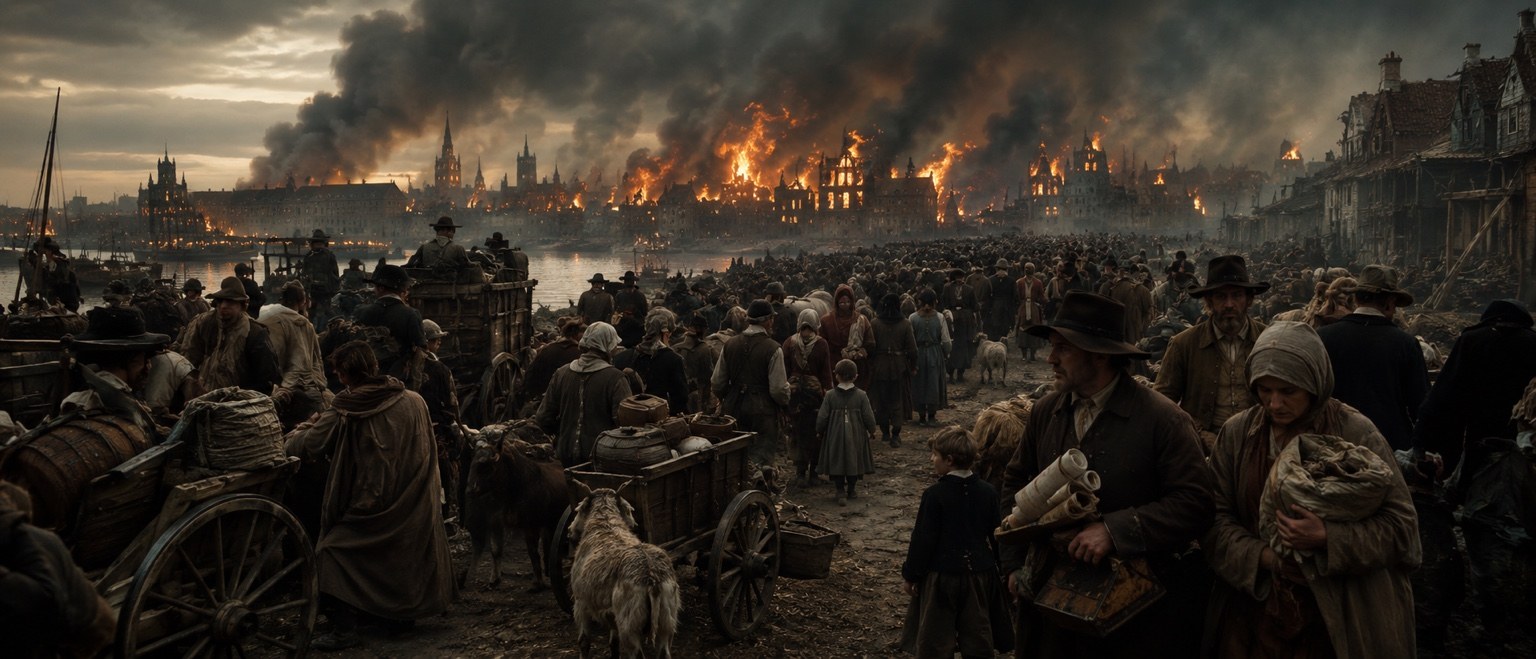
The sky is thick with smoke from the east, a strong wind driving clouds across London.

Servants load carts.

Trunks.

Silver.

Household goods.

The Ashcombe estate reduced to a small convoy.

Agnes and Isabel climb into a carriage.

Robert joins them, a leather portfolio tucked beneath his arm.

He looks to Agnes.

"It is done. I saw Vyner."

"I trust he gave you a fair price."

Robert smiles faintly.

“Then you are too trusting, dear.”

A beat.

“But, he gave me a speedy price.”

A servant appears at the carriage door.

"The smoke is from Pudding Lane, ma’am."

He glances east.

"Another fire."

Agnes nods.

"Oh good. That is far."

The servant waits.

Unsure whether he should be reassured.

Robert spares him the trouble.

"We are ready."

The servant nods and closes the door.

Outside, the drivers call to their horses.

The convoy begins to move.

Agnes looks to Isabel.

"You are certain you do not wish to bid farewell to Thomas?"

Isabel meets her mother’s gaze.

"Yes, Mother."

A half-truth.

The carriage lurches forward.

And carries them away from the life they have always known.

In Billingsgate the river is alive with traffic.

Barges.

Wherries.

Merchant vessels.

Smoke hangs over the eastern horizon.

Darker than it was yesterday.

Thomas watches it for a moment.

The city seems determined to wear his mood.

He has spent the better part of a week drifting through his days like a man moving through fog.

Now London does the same.

A bell rings somewhere downstream.

Then another.

The sound carries across the water.

Word has spread of the spread of more fires.

A runner pushes through the crowd.

"It was the French that done it! They set the fires."

Another voice joins in.

"There was one down by the fish market. Shifty face."

That is enough.

A commotion erupts further along the quay.

Thomas turns.

A crowd has surrounded a man.

The man is terrified.

Trying to explain.

Trying to make himself understood.

No one is listening.

"He has a tinderbox."

"Look at him. He’s Dutch."

“No, I’m not.”

"Hang him."

The crowd surges.

“I was born in Southwark!”

“Liar!”

Someone strikes the man across the face.

Thomas pushes forward.

"Stop."

No one hears him.

Another blow.

The man falls.

Thomas shoves through the crowd and throws himself between them.

"Enough."

A voice shouts back:

"He’s Dutch."

Thomas looks down.

He recognizes him.

“He is not.”

A warehouse clerk. A man he has seen on the docks for years.

The man mutters, “I said that.”

A simple Englishman with stilted speech.

Not an invader.

Not an arsonist.

Just unlucky.

Thomas turns back to the crowd.

"He is English. Besides, if the Dutch wished to burn London, they would not begin with their own warehouses."

The mob hesitates.

Only briefly.

Fear is stronger than reason.

Someone steps forward.

"Move."

Thomas does not.

The man raises a cudgel.

Thomas never takes his eyes off him.

"Then strike me first."

Another man moves toward him.

Thomas does not move.

Around them, smoke drifts across the river.

The city igniting.

The crowd begins to lose its certainty.

One man lowers his weapon, under his breath “Spoil sport.”

Then another.

At last, they disperse.

Not convinced.

Simply looking for an easier target.

Thomas helps the man to his feet.

"Thank you."

“You’re hurt?”

The Man touches split lip.

“No.”

Thomas watches the crowd disappear into the smoke.

“You should leave while you still can. They say with this wind Lombard Street will burn tonight.”

Thomas frowns.

“Who says?”

“Everyone.”

A beat.

“A family I know lives near there.”

“Then I’d tell ’em, quick. That’s why the goldsmiths are moving their gold to the Tower.”

Thomas turns and runs.

The Ashcombe convoy inches north through the city.

What should have taken an hour has consumed most of the day.

Carts stand axle to axle.

Servants shout.

The wind whipping ash around the dense air.

Horses rear.

Families drag trunks through the streets.

Isabel, “Everyone is leaving.”

Every church bell in London seems to be ringing.

Smoke hangs over the rooftops.

Unsavory men brandishing weapons appear from the alleys, kicking down doors.

“Over here, there’s a bloody Frenchman.”

A man screams.

Agnes pulls at Robert’s arm, “Robert, this is no small fire.”

Others men dash around wagons, pilfering what they can.

“Stop! Thief.”

Farmers drive livestock through the street.

The screams become constant.

A servant returns from ahead.

Breathless.

"The gate is blocked."

Robert frowns.

"Blocked?"

"People as far as the eye can see, sir. Carts, wagons, livestock. None moving."

Another servant arrives.

"They say Bishopsgate is closed."

"Closed?"

"They say the Lord Mayor ordered it."

“Father, the mood is turning violent.”

A third voice:

"The French are outside the walls."

A fourth:

"St. Magnus has burned."

The city no longer behaving as it should.

The convoy advances another hundred yards.

Stops.

Advances another fifty.

Stops again.

A woman pushes past carrying a child.

A man drags a heavy chest through the crowd.

Two others suddenly seize him.

The chest crashes into the mud.

The man shouts in protest.

Someone cries:

"Foreigner."

Another:

"Dutch bastard."

The crowd swallows him.

Robert hears the first blow before he loses sight of them.

Somewhere nearby, glass shatters.

The mood is changing.

Not panic.

Not yet.

But close.

Robert looks north.

Nothing but people.

He looks south.

More people.

The city itself has become an obstacle.

Isabel speaks.

"Look."

She points east.

Beyond the rooftops.

Beyond the church spires.

A wall of smoke stretches across the horizon.

And beneath it—

Fire.

Not a distant glow.

Not a rumor.

Fire.

It is no longer behind them.

It is coming.

Robert stares at it.

He looks at the wagons.

The silver.

The trunks.

The life he built.

Then the crowd.

Robert steps down from the carriage.

“Leave the convoy.”

The servants stare.

“Sir?”

“Take only what you can carry.”

A beat.

“Move.”

Bedlam near Aldgate. Henry crashes into a wagon wheel, dropping his dagger.

Another man falls screaming.

Steel flashes.

Henry’s guards drive the looters backward.

A club swings.

A sword answers.

A merchant’s convoy has become a battlefield.

"Push them back!"

A guard slams a man into a wall.

Another looter stumbles into the street clutching a broken arm.

The rest begin to retreat.

One of Henry’s men breathes.

"That’s the last of them."

For the first time all afternoon, Henry takes a breath too.

“Look lively, men. Don’t let your guard down.”

Henry and his servants push on his convoy of gold.

Wagons creak forward.

Guards reform around them.

A clerk wipes blood from his face.

"We’ll reach the Tower before dark."

Then they round a corner.

And stop.

Ahead.

A narrow lane.

Buildings burning on either side.

The center still open.

For now.

"We can get through there."

The men exchange uncertain looks.

They can already feel the fire’s.

A clerk says:

"We should go around."

A guard shakes his head.

"By then the fire will have beaten us to the gate."

Henry studies the lane.

No good choices.

Only less bad ones.

"Go."

The convoy enters.

The lane narrows.

A burning beam crashes into the street behind them.

Cutting off retreat.

Burning fragments tumble from the rooftops.

The horses grow restless.

One wagon squeezes past a burning doorway.

Then another.

They are almost through.

Almost.

A crack echoes overhead.

Everyone looks up.

The upper story of a burning building lurches forward.

For a moment it seems to hang there.

Then it falls.

The entire facade crashes into the street.

A horse screams.

The lead wagon overturns.

A second slams into it.

The convoy grinds to a halt.

A chest bursts open.

Ledgers scatter into the air.

The wind catches them.

Carries them into the flames.

"No!"

Several clerks rush forward.

Trying to save the wagons.

Trying to save the records.

Trying to save everything.

Then comes another crack.

The building opposite begins to collapse.

Burning timbers rain into the trapped convoy.

A wagon catches.

Then another.

His clerk throws himself beneath a burning wheel.

Straining to free it.

"We can still move it!"

"Philip!"

The clerk ignores him.

Still pulling.

Still fighting.

The flames climb higher.

Henry sees what everyone else refuses to.

It’s gone.

All of it.

"Philip!"

The young man looks up.

Desperate.

The wheel never moves.

Henry grabs him by the collar.

Drags him away.

"Sir—"

"Leave it."

"The ledgers—"

"Leave them."

"The accounts—"

Henry looks at the burning wagons.

At the papers.

At thirty years of work.

Then back at Philip.

"It’s not worth your life."

A burning beam crashes through the nearest wagon.

The fire takes the rest.

Henry watches for a moment.

Then turns away.

"Go."

Thomas reaches the Ashcombe House, panting.

Front doors open.

Servants carrying furniture.

Others abandoning it.

"Where is Miss Ashcombe?"

"Gone."

"Gone where?"

"North with her family, sir."

"When?"

"This morning."

Thomas absorbs that.

Before the fire.

Before the panic.

Before the city began to fall apart.

She left.

Without saying goodbye.

Thomas turns and runs.

Night has fallen.

The city is almost unrecognizable.

Smoke blots out the moon.

The streets glow orange.

Refugees move through the darkness carrying whatever they managed to save.

A lifetime reduced to bundles.

Robert leads the way.

Agnes beside him.

Isabel close behind.

The servants struggling beneath bags and strongboxes.

Every few moments another bell begins ringing somewhere in the city.

The sound never seems to stop.

Ahead.

A group of men block the street.

Not watchmen.

Not soldiers.

Something else.

They study the crowd as it passes.

Looking for weakness.

Looking for opportunity.

Robert slows.

One of the men notices the strongbox.

Another notices Agnes.

A third steps into their path.

"Where are you headed?"

Robert does not answer.

The man smiles.

"You look rich."

The others spread out.

Closing the street.

A servant shifts nervously.

Another grips the handle of a trunk.

The leader points toward the strongbox.

Robert, "Leave that."

No one moves.

The man takes a step toward Agnes.

"Perhaps we’ll take the lady’s jewels too."

Agnes recoils.

Robert steps forward.

The man shoves him back.

Hard.

Robert stumbles.

The man moves again for Agnes.

But Isabel steps between them.

The man grabs her arm.

“Oh, you fancy some of me, do you?”

The other men laugh.

The man turns his head toward his men basking in the laughter.

Then Isabel moves.

She seizes his collar and drives steel to his throat.

The metal flashes in the firelight.

A dagger.

Pressing. A prick of blood appearing.

Everyone freezes.

Including Robert.

The man goes quiet, then:

“You can’t think you can take us all on?”

“I need only kill you.”

The man realizes she is serious.

Silence.

The men exchange glances.

The blood.

The blade.

Then slowly raises his hands.

“Easy.”

A beat.

The leader calls out.

"Back away."

The group melts back into the darkness.

She shoves the man away.

He retreats.

The street breathes again.

Agnes turns.

Staring at the dagger.

Then at her daughter.

Robert does the same.

For the first time in his life, he sees something new in Isabel.

Somewhere nearby, another building collapses.

Robert looks north.

"Keep moving."

They disappear into the smoke.

The streets packed with refugees the farther north they travel.

Families.

Servants.

Merchants.

The entire city seems to be walking.

Smoke hangs low above them.

The ringing church bells now a constant accompaniment.

Robert glances back.

The glow in the south has grown brighter.

Closer.

A voice cuts through the crowd.

"Isabel!"

She freezes.

Certain she imagined it.

Then again.

"Isabel!"

She turns.

A figure forcing his way through the refugees.

Covered in soot.

Breathless.

Thomas.

Disbelief.

Relief.

Isabel moves toward him.

They embrace.

Briefly.

Tightly.

Then let go.

Reality returning all at once.

Thomas reaches the rest of the family.

Bent over.

Trying to catch his breath.

Agnes is first to speak.

"Thomas."

Agnes, “You came.”

Thomas, "I had to."

His eyes find Isabel.

She looks away.

Robert studies him.

Thomas, "I have a boat."

Everyone goes still.

Thomas points south.

"A captain I know. He’s waiting at Billingsgate."

For the first time all day:

Hope.

Real hope.

The crowd surges.

Pushing them forward.

Thomas looks south.

Then back to the family.

"This way."

And together they turn toward the river.

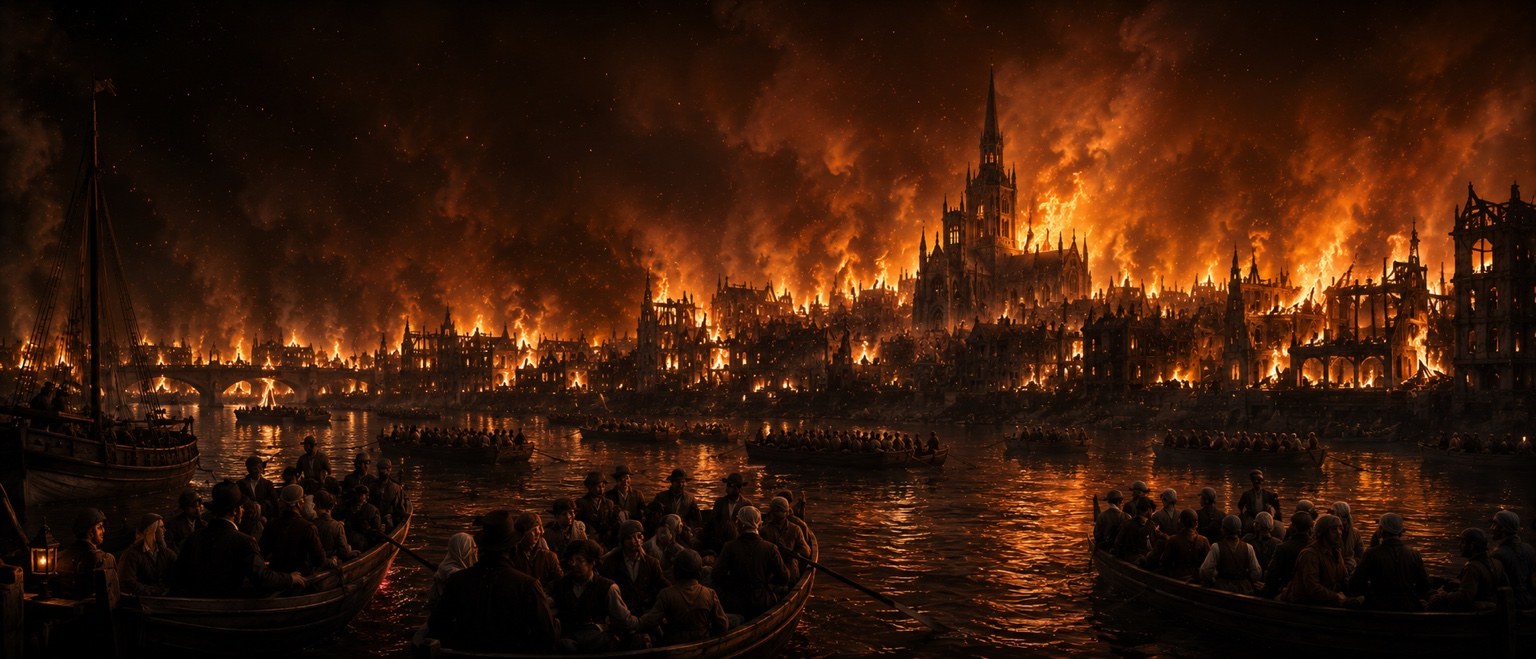
As they approach the river, the scale of the disaster reveals itself.

Warehouses burn along the waterfront.

Wharves have collapsed.

The Thames glows orange with reflected fire.

Boats choke the river.

Refugees scream for passage.

Furniture.

Silver.

Entire fortunes being loaded onto barges.

Then Thomas sees it.

The boat.

Waiting exactly where he arranged it.

The boatman sees him.

Raises an arm.

For one brief moment they believe they are saved.

Then they see the problem.

The wharf between them and the boat is burning.

Crowds packed shoulder to shoulder.

A warehouse collapses into the river.

The route disappears.

The boat remains visible.

Close enough to see.

Impossible to reach.

The escape route dies.

The crowd carries them west.

Everyone repeating the same thing:

"Go to St Paul’s."

"It cannot burn."

"The cathedral is safe."

Stone.

Open ground.

The largest building in London.

If nowhere else is safe, St Paul’s must be.

The Ashcombes arrive with Thomas.

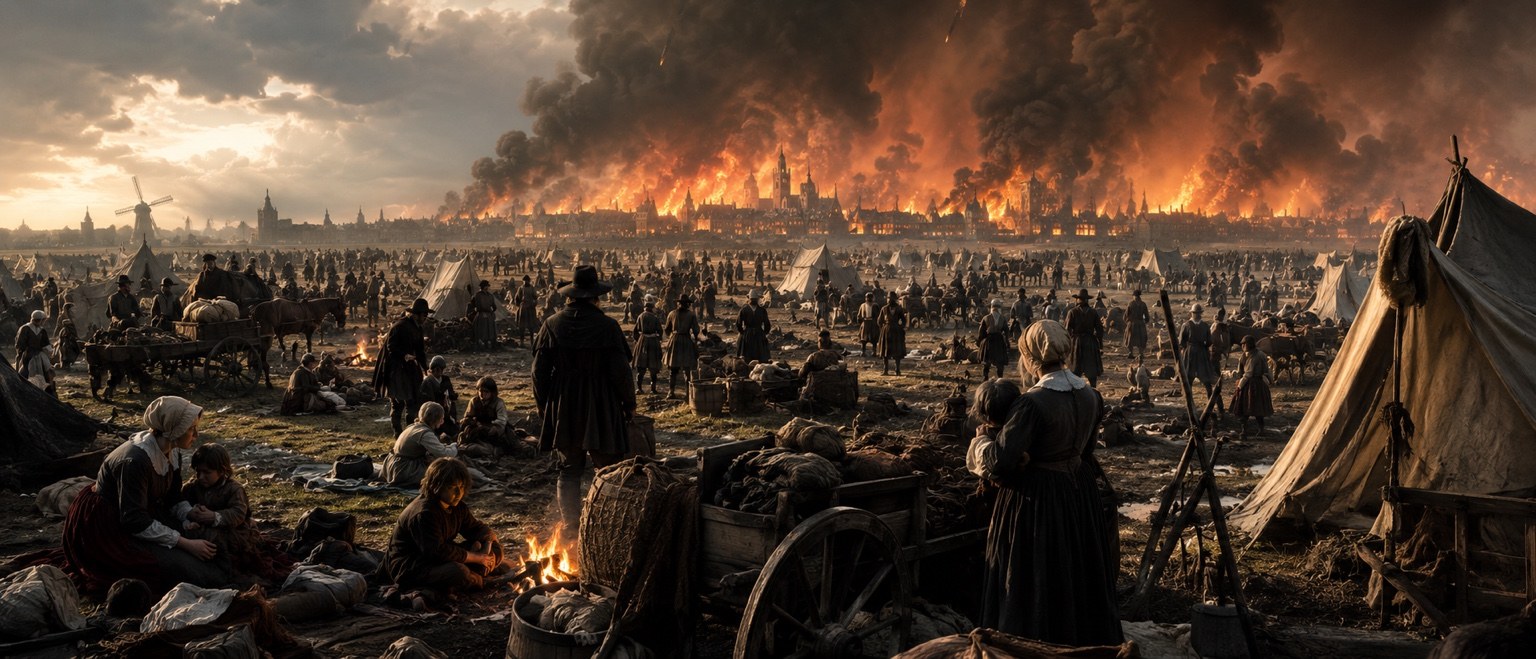
The cathedral precinct has become a refugee city.

Families.

Merchants.

Servants.

Carts.

Furniture.

Ledgers.

Silver.

Everything people managed to save.

For the first time since morning, they begin to believe they may live.

The cathedral feels like another world.

Beyond its walls London burns.

Inside, thousands seek refuge.

Families sleep upon cloaks.

Merchants sit beside piles of silver and ledgers.

Children cry themselves to sleep in their mothers' arms.

Priests move among the crowd offering prayers no one truly listens to.

For the first time all day there are no decisions left to make.

No road to choose.

No gate to reach.

No river to cross.

Only waiting.

Even Robert finally allows himself to sit.

Thomas removes his coat and places it around Isabel’s shoulders.

She starts to protest.

He does not allow it.

Their eyes meet.

A thousand words pass unspoken.

Nearby, Agnes leans against Robert.

Exhaustion overtakes them both.

The bells continue in the distance.

But farther away now.

As though the city itself were burning somewhere beyond the world they inhabit.

A human scene.

People eating scraps.

Bandaging wounds.

Trying to sleep.

Watching the glow in the distance.

For a moment it feels like they might survive.

Thomas goes off to seek word of his father.

Thomas moves among the refugees.

Listening.

Asking questions.

Every man carries a different version of the city.

"The river’s gone."

"The King has fled."

"The Dutch are in Southwark."

No one knows anything.

Then:

"Three men killed near the Tower."

Another voice:

"Over silver."

A merchant shakes his head.

"Men are murdering for less than that tonight."

Thomas goes still.

"Merchant convoys?"

The man nods.

"Goldsmiths. Traders. Anyone carrying wealth."

Thomas says nothing.

He does not need to ask another question.

He already knows.

His father would be moving his gold.

Robert turns to Isabel.

He speaks quietly.

Not confession.

Not redemption.

Preparation.

“If I do not survive this, you must. Live.”

Isabel studies him.

“Do not allow my failings to define your future.”

And once again she sees the man who raised her.

Agnes understands the deeper meaning.

He believes he may die.

A not-so-distant crackling sound.

Then another.

People begin looking upward.

Murmuring swells reverberating off the high ceiling.

St Paul’s is stone.

The safest place in London.

Then burning debris begins falling.

The crowd grows uneasy.

A cry goes up near the western transept.

Smoke.

Then flame.

Someone laughs nervously.

"It’s only the scaffolding."

Then another cry.

The roof catches.

Lead begins melting.

Books burn.

The great cathedral starts to die.

Fiery timber begins falling.

A woman catches alight.

Then another.

Disbelief becomes panic.

Smoke. Coughing. Fire.

If St Paul’s can burn, nowhere is safe.

The floor becomes a stampede.

Fiery projectiles descending.

Molten lead pours from the roof.

Burning timber falls.

Sparks descend like rain.

Thomas pushes his way against a sea of people.

Again, looking for Isabel.

In the chaos, they somehow find one another.

The Ashcombes and Thomas emerge into a city of fire.

Refugees stream north toward Moorfields.

Thomas looks east.

The glow over the Tower.

Isabel knows before he speaks.

“I have to find my father.”

She nods. “We will manage.”

Thomas, “Don’t stop moving. Nowhere is safe.”

“Go.”

Thomas, “I will find you.”

And he kisses her.

Not for what they have lost.

For what they might still have.

And he heads east.

Into the fire.

Thomas moves.

Against the tide.

Refugees flee west.

He alone walks into the fire.

The streets near the Tower are almost unrecognizable.

Burned wagons.

Dead horses.

Abandoned chests split open in the road.

Silver scattered in the mud.

A city stripped of pretense.

Thomas searches faces.

Calls out.

No answer.

Then—

A familiar ledger.

Scorched.

Stamped with the Blackwell mark.

Nearby.

A wheel from one of his father’s wagons.

Burned black.

Thomas goes still.

He is too late.

Then he hears shouting.

Not far off.

He runs toward it.

A narrow street.

Collapsed timbers.

Flames on either side.

A handful of men trapped behind burning debris.

Philip.

Two guards.

And Henry.

Covered in soot.

One arm bloodied.

Trying to move a fallen beam.

Behind it—

Three men pinned beneath the wreckage.

The fire creeping closer.

"Father!"

Henry turns.

For a moment he does not believe what he sees.

"Thomas?"

A burning beam crashes nearby.

The horses panic.

The fire advances.

No time for reunion.

Thomas and the guards heave at the timber.

Once.

Twice.

It moves.

The trapped men crawl free.

The fire takes the street seconds later.

The group stumbles into open ground.

Breathing hard.

Alive.

Father and son embrace.

Henry looks back.

Toward the east.

Toward the Tower.

Toward thirty years of work.

Gone.

"The gold?"

Thomas shakes his head.

"Gone."

Henry nods.

Not anger.

Not grief.

Only exhaustion.

"Good."

Thomas looks at him.

Henry manages the faintest smile.

"Riches come and go."

He looks at his son.

"Family remains."

A beat.

"The mistakes of old fools have ruined enough lives."

Henry places a hand on his son’s shoulder.

"Do not let them ruin yours."

Thomas lowers his eyes.

"She made her choice."

Henry studies him.

“Did you?”

Thomas says nothing.

Henry nods.

"Then change her mind.”

Thomas says nothing.

A beat. Henry:

"It’s all that matters."

The city glows behind them.

London dying.

Father and son turn north.

Toward Moorfields.

Toward whatever remains.
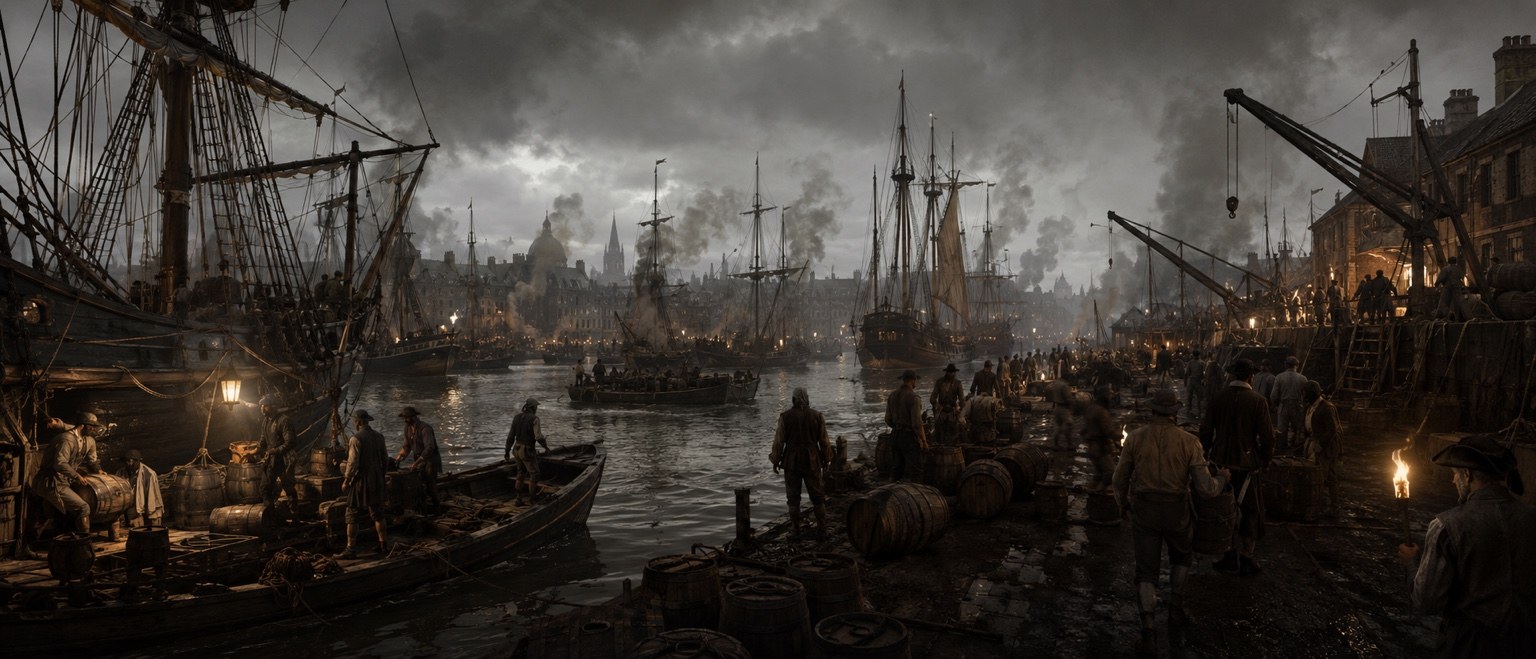
PART XI

WHAT IS LEFT

Moorfields refugee camp
What is left

The first light of dawn breaks over Moorfields.

The fires still burn to the south.

But here for the first time there is air enough to breathe.

Thousands fill the fields.

Blankets.

Wagons.

Refugees.

Merchants guarding the ruins of their fortunes.

Families with nothing at all.

The city of London lies beyond the walls.

Burning still.

The Ashcombes sit together in silence.

No one speaks.

There is nothing left to say.

Robert holds the leather portfolio.

The last remnant of a life built over twenty-five years.

Nearby, Isabel scans the crowd.

Waiting.

At last—

two figures emerge from the smoke.

Thomas.

And beside him—

Henry.

Alive.

Relief washes over Isabel before she can hide it.

Thomas sees.

They embrace.

Not as lovers.

As two people who feared they would never see one another again.

They separate.

But neither lets go.

“You found me.”

“I said I would.”

Henry embraces Agnes.

Then Isabel.

Finally, his eyes find Robert.

The two old men regard one another across a lifetime.

Robert quietly withdraws to a nearby tree granting Henry the courtesy of distance.

Henry watches him go.

A long moment.

Then Henry follows.

The fire burns on the horizon.

The city between them.

The years between them.

Robert extends the portfolio.

"Take it."

Henry frowns.

"What is this?"

"Enough for you and Thomas to begin again."

Henry does not reach for it.

Robert’s arm remains outstretched.

The weight of twenty-five years heavy in his hand.

"I know it changes nothing."

A beat.

"But it is yours."

Henry studies him, then:

“It is not mine to have.”

Robert struggles to answer.

At last—

a whisper.

“It was not mine either.”

Henry closes his eyes.

Only for a moment.

When he opens them again, the fire still burns.

He leaves the portfolio in Robert’s hand.

Not forgiveness.

Never that.

Only acceptance.

The world before the fire is gone.

Henry looks toward Thomas and Isabel.

Standing together.

Alive.

The two old men sit down in silence.

Watching London burn.

Some days later.

Moorfields has become an established refugee camp.

Robert and Isabel finish packing up what little provisions they can muster.

Isabel approaches her parents.

The stop and regard their daughter.

Each know what is coming.

Isabel starts to speak.

Her voice caught in her throat.

The tears come first.

“Father, Mother…”

Robert and Agnes cry as well.

They embrace their daughter.

“It is ok, my darling.”

“I – I…”

They separate, hold each other’s hands.

They breathe.

Robert finds his courage, looks to Agnes.

Looks back to Isabel.

Manages to find his voice amidst the emotion.

“My love. You must make your own life.”

More tears as they hold each other.

Isabel nods.

Robert reaches down.

Lifts the leather portfolio.

She recognizes it immediately.

He places it in her hands.

She looks at him, confused.

“Father?”

Robert closes her fingers around it.

“Take it.”

She begins to protest.

He gently shakes his head.

“No father can give his child enough.”

A beat.

“It is right.”

Their eyes meet.

Both knowing he means more than money.

Robert kisses her forehead.

As he did when she was small.

“For whatever comes next.”

Agnes brushes a tear from Isabel’s cheek.

“Go on, my love.”

Robert releases her hand.

And for the first time in her life—

lets her go.

A tavern.

The sort of place men go when they no longer care if they sleep.

London rebuilds outside.

Brick by brick.

A drunkard slumps at the bar.

A man who seems not to have moved in days.

A shadow falls across him.

Pelham looks up bleary-eyed and drunk.

Henry Blackwell.

Henry removes his gloves.

Takes the seat beside him.

“I’ve been looking for you, Pelham.”

Pelham scoffs.

The idea that anyone would be searching for him novel.

A beat.

Neither man speaks.

At last, Henry:

"You got your wish.”

Neither a question nor an accusation.

Pelham does not move.

“He had to pay.”

Henry nods.

“And you feel recompensed?”

For the first time, Pelham falters.

Henry smiles wanly.

“You did not break them.”

“What?”

“You did not break them.”

"Thomas and Isabel."

A beat.

"They found one another."

Pelham does not know how to feel.

Henry rises and starts to walk away from the broken man.

“Hold on. Mr. Blackwell, wait!”

Henry pauses and turns.

“You came all this way to tell me that?”

Then chooses his words carefully.

“Consider it a gift.”

But really, it’s a curse.

Henry turns again and leaves.

Pelham calls after him.

“Where is he?

Henry does not turn.

Continues walking away.

“He died in the fire.”

Pelham absorbs this.

Empty.

Broken.

Alone.

Outside—

London rebuilds.

Thomas and Isabel looking toward the future
Only the future.

A ship pulls away from England.

Thomas and Isabel stand together at the prow.

Behind them, London fades into the horizon.

No words.

Only the future.

END MATTER

THE GREAT FIRE OF LONDON

London as it was before the Great Fire, showing the destroyed area
The area destroyed by the Great Fire, 2–6 September 1666.